

One of the ideas I shared during the Autistic Burnout Conference has stayed with me, because it explains something so many neurodivergent people describe but rarely see reflected in sleep advice.
If you’ve ever been told to “switch everything off before bed” but found that it actually makes your brain feel louder, this might be one of the reasons why.
A quick introduction to monotropism
Monotropism is a theory of Autistic attention (Murray et al., 2005). Rather than attention spreading across lots of different things at once, monotropic attention tends to gather deeply around fewer things. When something captures your attention, your nervous system often wants to stay with it, explore it, understand it, and complete it before moving on.
It’s a different way that attention is organised.
While the theory was originally developed to explain Autistic experience, many neurodivergent people have also found the framework resonates with their experiences of attention and regulation.
Like any attention style, it has strengths and challenges. Deep focus can bring creativity, expertise, joy and regulation. But being constantly pulled away from that focus can be exhausting.
What happens during the day?
Now think about what many neurodivergent adults experience across a typical day.
- Your attention is pulled in every direction.
- You’re expected to stop one task before you’ve finished processing it.
- You switch between conversations, emails, notifications, meetings and household demands.
- You monitor other people’s emotions.
- You suppress the urge to return to the thing your attention naturally wants to stay with.
- You force yourself to keep shifting because that’s what daily life requires.
From the outside, it can look like you’ve managed the day perfectly. Inside, your attention may have been fragmented hundreds of times.

Image from Canva by nilsz from Getty Images
You may also be interested in my other sleep blogs ‘Waking Up Can Be Hard: Understanding Sleep Inertia and Easing Into the Day’, ‘The Power of a Tiny Nap: Why even a few minutes can make a difference’, or ‘The Need for Co-regulation Doesn’t Stop at Night’
The attention loops that never get to finish
One way I think about this is that every interruption creates an unfinished attention loop.
- Your brain was heading somewhere
- It was making connections
- It was settling into something
- Then it had to stop
- Again
- And again
- And again
By evening, your body may be physically tired, but your attention hasn’t actually had many opportunities to settle.
Instead of moving from activity into rest, your nervous system has spent the day in a state of continual interruption (ugh).
Why your preferred interests might matter
This is where preferred interests can become important. Preferred interests are incredibly enjoyable.
And I also wonder whether they also serve another purpose.
If your nervous system has spent all day adapting to fragmented attention, perhaps your preferred interest offers something that has been missing.
- Time (uninterrupted)
- Continuity
- Completion
- The opportunity to stay with something for long enough that your attention can finally settle
- Regulate through immersion
Your nervous system and attention are finally allowed to do what it has been prevented from doing all day.
From vigilance to safety
When attention can stay where it naturally wants to be, something often changes.
- Your breathing may slow
- Your muscles may relax
- Your thoughts become less scattered
- You stop monitoring everything around you quite so intensely
- Your nervous system begins to move away from vigilance and towards safety
And this all matters because sleep isn’t something we can force ourselves to do. Sleep happens when the nervous system feels safe enough to let go.
Perhaps, for many autistic people, focused engagement isn’t keeping us awake. Perhaps it’s helping us become the kind of settled that makes sleep possible.
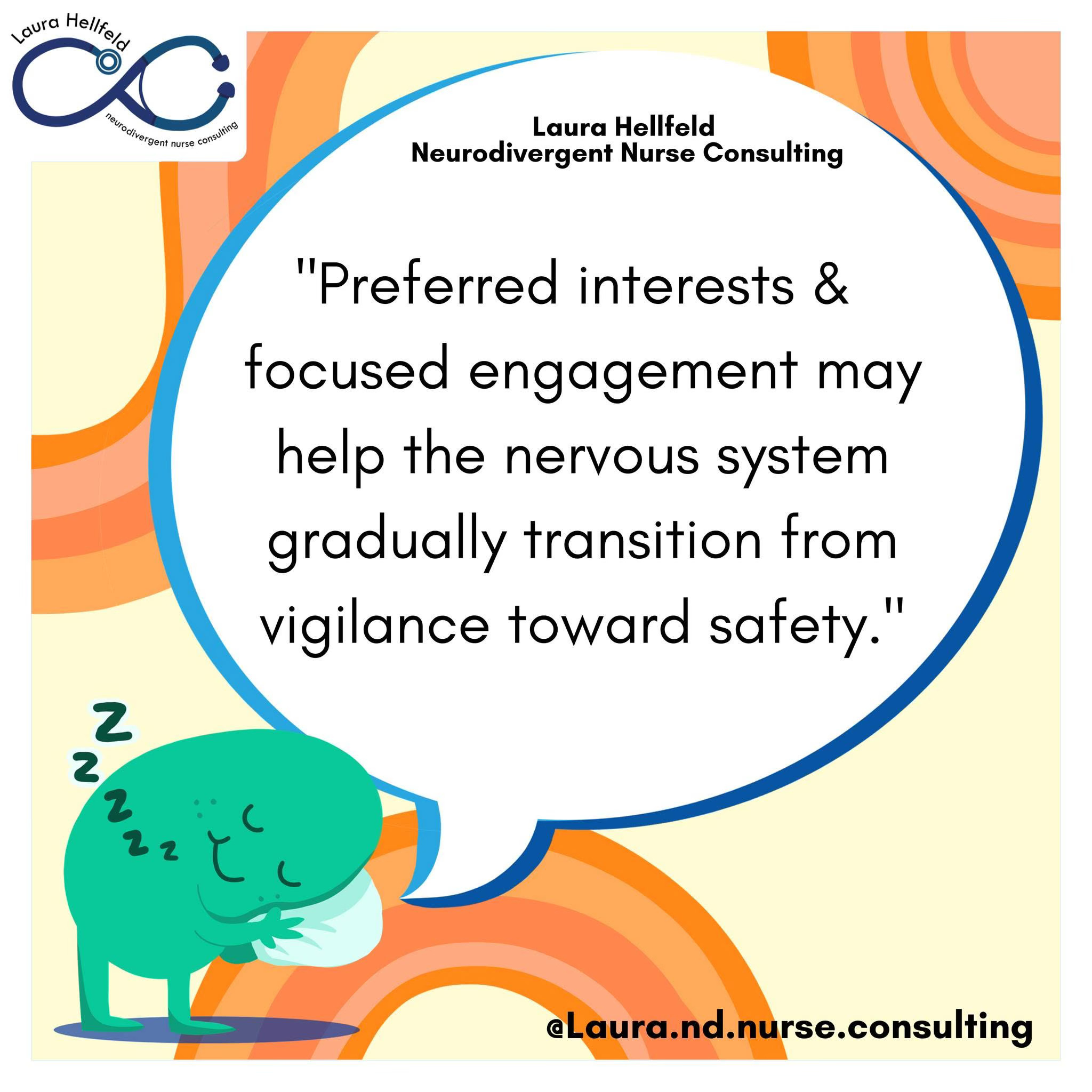
Therefore, preferred interests and focused engagement may help the nervous system gradually transition from vigilance toward safety. And it’s felt safety that supports us to sleep.
I’d love to know whether this resonates with your experience. Does engaging in a preferred interest before bed make it easier for your nervous system to settle, or does your brain need something different?
Thank you for being here,

Laura Hellfeld
RN, MSN, PHN, CNL
Connect with me on social media
Instagram, Facebook LinkedIn and BlueSky
Disclaimer: The information shared in this blog is for informational purposes only and is not intended to replace medical advice, diagnosis, or treatment. Please consult a licensed healthcare provider for personalised support and care tailored to your specific needs.
Signposting and Resources
- Flush Forward!: A Friendly Toileting Guide for Parents Supporting Disabled and Neurodivergent Young People, Book
- Creating Safe Spaces for Autistic People, Book
- Gabby’s Glimmers: An Affirming Story of an Autistic Child and their Favourite Food, Book
- Murray, D., Lesser, M., & Lawson, W. (2005). Attention, monotropism and the diagnostic criteria for autism. Autism, 9(2), 139–156. https://doi.org/10.1177/1362361305051398
- Waking Up Can Be Hard: Understanding Sleep Inertia and Easing Into the Day, Blog
- The Power of a Tiny Nap: Why even a few minutes can make a difference, Blog
- The Need for Co-regulation Doesn’t Stop at Night, Blog
Last modified: 22 June 2026